Eagle Flight Academy South Africa is a Aviation training institute establishment in Hartswater, Northern Cape, South Africa
Eagle Flight Academy South Africa — Aviation Training Institute (Hartswater, Northern Cape)
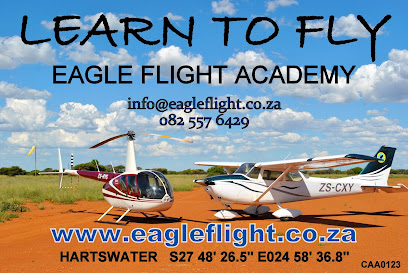
Situated at Eagle Flight Aerodrome near Hartswater in the Northern Cape, Eagle Flight Academy operates as an approved South African Civil Aviation Authority (SACAA) flight training organisation. The academy presents itself as a dedicated provider of premium pilot training for both international and domestic students, with an emphasis on developing professional pilots who possess genuine operational capability, all within a framework designed to deliver value-driven training costs.
The core offerings span a comprehensive pathway from initial private pilot qualifications through to commercial and instrument-rated multi-engine flight credentials. The Private Pilot Licence (PPL) and Commercial Pilot Licence (CPL) programmes are complemented by a National Pilots Licence (NPL) option, and the organisation provides guidance on validating foreign licences for South African-registered aircraft (ZS) under JAA (EASA) and FAA frameworks. This breadth enables students to select a process aligned with their career aims, whether pursuing domestic or international aviation opportunities.
Training is anchored in structured syllabi that align with ICAO and SACAA standards. The academy highlights its use of traditional piston and light aircraft fleet, including Sling 2 models, Piper Cherokee 140s, Mooney M20s, and Piper Semin ecas, as part of its flight training fleet. The fleet is described as being owned and operated by the school, providing students with consistent and well-maintained aircraft for instruction. The instructional approach is described as based on hours and pacing consistent with established European Joint Aviation Authorities (JAA) syllabi, thereby supporting learners who are aiming for airline-style training and progression.
With a clearly defined progression pathway for Private Pilot training, Eagle Flight Academy emphasises a practical, hands-on learning experience. The Private Pilot training for single-engine piston aircraft focuses on safe and efficient day Visual Flight Rules (VFR) flying, as a foundation before advancing to more complex operations. The academy notes that a PPL course commences every six weeks, with an anticipated duration of around twelve weeks for completion, reflecting a predictable cadence for students and a strong emphasis on efficient time utilisation for flight hours and study.
Beyond the PPL, the academy offers Commercial Pilot Licences, including the CPL for single and multi-engine operations, along with options for multi-engine Instrument Rating (MEIR). The inclusion of multi-engine and instrument-rated pathways suggests a training philosophy designed to support students aiming for airline careers or other professional flying opportunities. The organisation also addresses practical aspects of licencing for foreign-trained pilots wishing to operate in South Africa, indicating a straightforward route for validation of non-local qualifications when paired with appropriate PIC support or safety pilot requirements.
Prospective students can access a range of resources through the site, including a Private and Commercial prospectus, a flight training quotation (noting that figures are indicative and subject to variation), and frequently asked questions. Additional documents include an application form for Private and Commercial pilot licenses. The combination of published materials and direct contact channels reflects a streamlined administrative process intended to help applicants understand costs, timelines, and prerequisites before enrolling.
Customer experiences, as reflected in visitor reviews, are largely positive, with numerous testimonials highlighting the quality of instruction, the professionalism of staff, and the supportive training environment. Reviewers frequently mention the high standard of training, the friendly and dedicated atmosphere, and the practical value of the experience. Descriptions of the facilities and aircraft are consistently supportive, reinforcing the impression of a well-maintained school with a strong community feel. Several reviews emphasise that training at Eagle Flight Academy can feel approachable and enjoyable, even for those new to aviation.
For potential students, practical tips include reviewing the available prospectuses and quotations to understand typical training costs and time expectations, noting the six-week cycling of PPL course starts, and becoming familiar with the SA CAA and ICAO standard expectations. Since the academy serves both international and domestic students, travellers should consider travel logistics, accommodation options near Hartswater, and the requirement for English language proficiency where applicable. The dual-location presence—Eagle Flight Aerodrome near Hartswater and Tempe Airfield in Bloemfontein—provides flexibility for applicants who may prefer different training environments within South Africa.
- Main services offered: Private Pilot Licence (PPL) for aeroplane and helicopter, Commercial Pilot Licence (CPL), National Pilots Licence (NPL), JAA (EASA) and FAA licence validations, single- and multi-engine flight training, instrument-rating pathways, and aligned ICAO/SACAA standards.
- Typical job types (as indicated by training scope): professional airline or charter pilots, commercial pilots, aircraft operation specialists requiring multi-engine and instrument competencies.
- How requests usually work: prospective students access prospectuses, quotations, and application forms via the site, with direct contact information provided for enquiries and admissions; training starts are scheduled on a six-week cadence, with programme durations outlined for PPL and related licences.
- Practical tips: review the downloadable prospectus and financial quotations, plan for six-weekly start cycles, verify licence validation options for foreign qualifications, and consider the fleet mix and base locations when planning travel and accommodation.
- Location and area served: based at Eagle Flight Aerodrome near Hartswater, Northern Cape, with another training base at Tempe Airfield, Bloemfontein; serves both domestic and international students seeking SACAA-aligned flight training.
Hartswater
Northern Cape
South Africa
Sorry, no records were found. Please adjust your search criteria and try again.
Sorry, unable to load the Maps API.
Aviation Training Institute Services in Hartswater, Northern Cape
An aviation training institute in Hartswater offers a range of services designed to prepare aspiring pilots and aviation professionals for practical operation and regulatory compliance in the South African aviation environment. These institutes commonly present a structured programme that blends theoretical knowledge with hands‑on flight and simulator experience, supported by qualified instructors and industry-standard facilities. The emphasis is on safety, professionalism, and the development of core competencies that align with national and international aviation norms.
Core offerings typically begin with ground school or theory courses. These cover aviation fundamentals such as air law, meteorology, navigation, communications, human factors, and aircraft systems. The learning is usually delivered through a combination of classroom lessons, multimedia materials, and guided self‑study. Students progress through modules at a pace that suits their background, with assessments designed to build a solid conceptual foundation before advancing to practical training.
Practical flight training constitutes another principal pillar. Trainees undertake flight lessons in appropriately licensed aircraft (or state‑of‑the‑art simulators where available) under the supervision of experienced flight instructors. Practical sessions focus on aircraft handling, take‑offs, landings, navigation, and emergency procedures, with an emphasis on precise technique, decision‑making, and adherence to established safety protocols. The training environment often fosters gradual skill development, moving from basic manoeuvres to more complex mission scenarios as proficiency improves.
Simulators and flight‑training devices may be utilised to supplement real‑world flying. These tools enable repetitive practice of procedures, instrument interpretation, and abnormal‑condition responses in a controlled setting. In some cases, simulator sessions are used to reinforce theory, consolidate skill retention, and provide supplementary training outside of actual flight hours. The availability and sophistication of simulators can vary between institutes, but the underlying aim remains consistent: to enhance safety and confidence while optimising the overall training timeline.
Ground handling and aviation support services are also commonly offered. Students and entrants learn about pre‑flight planning, weight and balance calculations, fuel management, maintenance records, and regulatory documentation. In addition to training in flight operations, institutes may provide guidance on industry expectations, career pathways, and professional development, helping learners understand licensing tracks, exam requirements, and potential progression routes within the South African aviation sector.
Facilities in Hartswater typically reflect the practical needs of aviation training. This includes secure classroom spaces with appropriate teaching resources, a reception area for student services, and access to maintenance and workshop spaces for basic aircraft knowledge demonstrations. Training airports or aerodromes nearby are essential to provide realistic airfield experiences, while on‑site safety systems and risk management practices help maintain a secure learning environment. Accessibility and transportation considerations are commonly weighed, given the regional setting and the importance of reliable routes to training venues.
Practical considerations for prospective students include assessing the duration and intensity of programmes, available funding or financing options, and the scheduling of lessons to accommodate work or study commitments. The best‑fit institutes tend to emphasise clear syllabus outlines, transparent progression criteria, and robust safety records. Prospective entrants may also want to consider the reputation of instructors, the alignment of the curriculum with current industry standards, and the level of post‑training support for employment or further training opportunities.
- Theory and examinations preparation
- Flight and simulator tuition
- Aircraft systems and maintenance awareness
- Safety, risk management, and regulatory compliance
- Career guidance and progression planning