Advantage Air is a Manufacturer establishment in Johannesburg, Gauteng, South Africa
Advantage Air / MyPlace Africa — Smart Home Solutions for Johannesburg and Beyond
Advantage Air’s MyPlace Africa brand operates as a supplier and integrator of smart home technologies centred on comfort, convenience and energy efficiency. Based with a head office in Johannesburg and a regional footprint that includes a Cape Town branch and an established network of MyPlace Authorized dealers across South Africa, the organisation positions itself as a practical, scalable solution for modern homes. The offering blends a modular hardware suite with intuitive software to create a centralised control experience for lights, climate, gates, blinds and related devices.
The core services focus on smart home automation and climate control. The MyPlace platform acts as the central hub, delivering one-user access to lighting, temperature management, garage doors, driveway gates and motorised blinds. Users operate these elements via a dedicated MyPlace app, a wall-mounted touch screen, or compatible voice assistants. A distinctive feature is the ability to access and manage home systems remotely from anywhere in the world, emphasising convenience for owners who travel or juggle multiple properties.
Three primary product strands anchor the practical offering:
- MyPlace — a complete smart home automation starter solution that consolidates control across several circuits from a single central hub. The package comprises a mobile app, a wired-in tablet, a control box and a connection box for up to six switching points, with modular expansion available to add further circuits as required. The emphasis is on straightforward setup and ongoing control of lighting, blinds, gates and other connected elements.
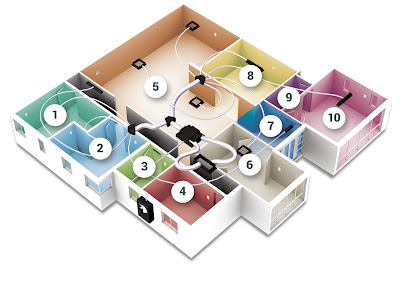
- MyAir — a smart air-conditioning system featuring up to ten independently controlled zones. It integrates with major air-conditioning brands and offers temperature control by room, remotely via the app, and on-device tablets. Optional sensors (temperature, motion) further support energy savings and personalised comfort across zones.
- MyLights — a lighting control platform designed to reduce energy use while enabling mood-setting and remote management. The MyLights ecosystem supports dimmable lighting and quick access through an 8-inch control hub, with compatibility to work in concert with MyAir and other Advantage Air technologies. The product is promoted as a cost-conscious alternative within the smart home market, emphasising energy efficiency and ease of use.
Additional innovations extend the product ecosystem. The company highlights modules and accessories such as MyG for garage door control, and collaboration with voice assistants (Google Home and Amazon Alexa) to enable vocal commands for scenes and device groups. Support materials, including downloadable manuals and setup guides, are available to help customers configure systems and leverage voice control features. The innovations section also references event-driven automation, motion and light sensing, and weather-aware tasks that can trigger routines within the MyPlace ecosystem, illustrating a broader vision for automated house management.
In terms of installation and project scope, the offerings are described as modular and scalable, with installation capable of fitting new builds or retrofits. Customers may engage through local dealers or the company’s own infrastructure, with a focus on practical deployment rather than high-cost bespoke systems. The presence of a product catalogue for components such as diffusers, dampers and ducting suggests an understanding of the underlying HVAC integration that complements smart control for integrated environments.
Typical projects described in the content align with residential environments seeking enhanced comfort, convenience and energy management. Common job types include upgrading living spaces with lighting and climate control, automating entry points through smart doorbells and cameras, and integrating voice command capabilities for hands-free operation. The Ring Video Door Bells and Outdoor Security Camera offerings indicate an interest in expanding smart security alongside climate and lighting solutions, creating a holistic home automation portfolio.
Practical tips for customers include planning the control points early in the design stage of a home to allow for seamless integration of MyLights and MyAir with the central MyPlace hub. When considering MyAir, evaluating room-by-room comfort and the potential benefits of ITC sensors or motion sensors can optimise energy efficiency. For lighting, mapping daily routines and desired mood settings helps determine the number of circuits and scenes that deliver maximum value. If pursuing installation, note that the Johannesburg head office and Cape Town branch support local coordination, with a network of authorised dealers available across South Africa to assist with deployment and aftercare.
Business hours and exact visiting times are not specified, but the organisation positions itself as a national supplier with regional coverage, suggesting that discussions with local dealers or the head office could be arranged during standard business hours through regional contact points. The service area is described as South Africa-wide, with particular emphasis on Johannesburg and Gauteng for headquarters activities.
Johannesburg
Gauteng
South Africa
Sorry, no records were found. Please adjust your search criteria and try again.
Sorry, unable to load the Maps API.
Manufacturer Services in Johannesburg, Gauteng
In Johannesburg, Gauteng, manufacturer services encompass a broad range of activities designed to transform raw materials into finished goods or components for other industries. This urban centre acts as a logistics and manufacturing hub, supported by a network of suppliers, engineering expertise and access to regional and international markets. The services typically emphasise efficiency, quality control and scale, while accommodating the diverse industrial profile of the province.
Core offerings often include production planning and scheduling to match demand with capacity, batch or mass production capable of handling varying volumes, and flexible manufacturing processes that can adapt to different product specifications. Operations frequently integrate assembly, fabrication, machining, tooling, casting or extrusion, depending on the sector. This variety supports industries such as automotive components, consumer goods, packaging, metalwork, plastics and electronics, reflecting the mixed economy of Gauteng.
Quality assurance remains a central consideration. Many manufacturers implement standardised inspection regimes, process control measures and documentation practices to track materials, production steps and final outputs. While formal certifications may be pursued in some facilities, customers can generally expect a strong focus on consistency, traceability and compliance with local and national regulations that affect product performance, safety and environmental impact.
Customer interactions in Johannesburg typically revolve around project briefs, timeline discussions and material specifications. Clients may provide design files or technical drawings, and manufacturers interpret these inputs into workable production plans. In turn, the service provider outlines feasibility, lead times, required tolerances and anticipated maintenance needs for machinery and tooling. This collaborative approach supports the delivery of customised or semi-customised solutions within a defined budget and schedule.
Logistics and supply chain considerations play a pivotal role. Proximity to major transport corridors, rail links and airports enhances sourcing of raw materials and distribution of finished goods. Inventory management, supplier relationships, and capacity planning are common priorities, alongside risk management strategies to mitigate delays caused by fluctuations in demand, currency movements or regional disruptions. Businesses often emphasise on-time delivery and reliable post-production support to maintain continuity for customers with ongoing or recurring needs.
Practical considerations for prospective clients include the following:
- Clear communication of product specifications, tolerances and performance criteria to minimise rework and delays.
- Assessment of minimum order quantities, batch sizes and lead times to align with project deadlines.
- Evaluation of material compatibility, sourcing options and costs to optimise value and quality.
- Discussion of after-sales services such as repair, refurbishment or spare parts availability where relevant.
- Awareness of local regulatory requirements and environmental considerations that may influence manufacturing processes.
Typical project workflows begin with an initial scoping discussion, followed by design interpretation or feasibility assessment, a material plan and a proposed production schedule. Once an agreement is reached, production proceeds in defined stages, with quality checks at key milestones. Regular updates, documentation of changes and a clear pathway for handling non-conformities help maintain alignment between the manufacturer and the client. Final delivery is accompanied by any necessary documentation, packaging considerations and, where appropriate, guidance on installation, integration or user expectations.
Overall, manufacturer services in Johannesburg, Gauteng, are characterised by their adaptability, logistical efficiency and emphasis on delivering workable, within-spec products that meet practical business needs. The sector supports a wide range of industries and provides a dependable route from concept to market, underpinned by established regional supply chains and access to skilled technical talent.