Flight Safety Africa / Helideck Certification-Africa is a Aviation consultant establishment in Knysna, Western Cape, South Africa
Flight Safety Africa / Helideck Certification-Africa: Aviation consultancy and helideck certification services
Operating from South Africa and positioned within the globally recognised Flight Safety Group, Flight Safety Africa (PTY) Ltd and Helideck Certification-Africa (Pty) Ltd deliver a comprehensive suite of aviation audit, risk management and compliance services tailored to offshore and aviation operations throughout Africa. The organisations emphasise accredited quality management and industry-standard practices, underscoring their ISO 9001:2015 certification and collaboration with industry bodies such as the South African Oil and Gas Alliance (SAOGA).
The primary offerings cover two linked domains: aviation audit and risk management services for fixed-wing and rotary operators, and complete helideck certification through Helideck Certification-Africa. The combined portfolio is designed to support safe, compliant and efficient offshore helicopter operations, including required certifications, inspections and training aligned with international standards.
Main services offered
- Global, fully certified aviation audit and risk management services: advisory and auditing support across aviation disciplines, designed to meet international requirements while catering for regional needs.
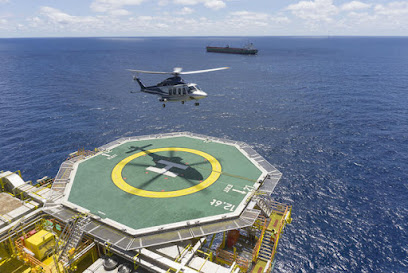
- Helideck certification and inspections: a complete helideck certification service applying UKCAA CAP 437 (Edition 9 February 2023) and ICAO Annex 14, Volume II standards. This includes the use of friction testing with the Findlay Irvine Micro Grip Friction tester – the UKCAA-approved device for CAP 437 compliance.
- Independent helideck inspections: qualified, independent HC-A inspectors based in South Africa conduct inspections and issue certifications at competitive local costs, with a procedure that reflects UKCAA CAP 437 guidance and IOGP standards.
- OPITO-equivalent offshore training: offshore training courses aligned with OPITO Standards, deemed equivalent to IOGP 690 requirements, ensuring compatibility with offshore industry expectations.
- Online and blended training: a portfolio of training courses, including helideck awareness and operational training, now available online with added desktop practical elements for certain courses (HERTM and HERTL).
- Offshore aviation training and auditing: comprehensive services for offshore operators, addressing both fixed-wing and rotorcraft operations across the African continent and beyond.
Typical job types and industries
The firm’s activity is centred on offshore oil and gas operations, where helicopters play a critical role in rapid and reliable crew transfer. The certification and inspection services cater to offshore platforms, while the associated training supports ongoing compliance for offshore crews and aviation personnel. The business also serves broader aviation safety and risk management needs for operators working in challenging environments across Africa.
How requests usually work
The offerings are structured to deliver highly tested, globally recognised standards locally. Helideck Certification-Africa leverages its UKCAA CAP 437 and ICAO-aligned checklists and procedures, supplemented by IOGP-aligned industry practices. Customers engage through accredited training courses, safety audits, and on-site helideck inspections carried out by qualified inspectors. The online training pathway enables attendees to complete theory remotely, with practical elements incorporated into the programme as applicable.
Customer experience and practical tips
Clients can expect a professional, standards-driven approach, supported by an ISO-certified quality management framework. The organisations’ association with the Flight Safety Group and SAOGA signals a focus on global best practices and regional relevance. Independent inspection by South African-based inspectors is highlighted as a cost-effective alternative to overseas providers, without compromising on compliance with CAP 437 and IOGP requirements.
Practical tips for customers include choosing online courses for flexibility, ensuring familiarity with CAP 437 and ICAO Annex 14 requirements when planning helideck work, and confirming the latest UKCAA-approved friction testing method if friction testing is a concern. For operators considering offshore training, it is advisable to reference OPITO-equivalence in course selection to meet offshore industry standards.
Notes on location and coverage
The organisations are based in South Africa and offer services across the African continent, with a focus on offshore helicopter operations. While the detailed local address in Knysna or Western Cape is not explicitly stated here, the operation is positioned to service clients within South Africa and neighbouring regions, delivering both on-site inspections and remote or online training where appropriate.
Western Cape
South Africa
Sorry, no records were found. Please adjust your search criteria and try again.
Sorry, unable to load the Maps API.
Aviation Consultant Services in Knysna, Western Cape
Aviation consultants operating in Knysna, Western Cape, provide professional guidance to a diverse client base, including charter operators, flight schools, maintenance organisations, tourist operators, and asset managers. The local context combines access to regional routes, a growing leisure and business aviation sector, and the proximity of George Airport, which together influence the scope of advisory work. Consultants in this area help organisations align aviation activities with regulatory requirements, practical operations, and strategic objectives while considering the unique geography and climate of the southern coastline.
Typical services fall into several core categories. Regulatory compliance and safety management form a foundational offering, guiding clients through South Africa’s Civil Aviation Authority (SACAA) rules, airworthiness standards, and přescribed documentation. This often includes assisting with safety management system (SMS) development or enhancement, flight operations manuals, and hazard reporting processes to promote a proactive safety culture across crews and ground staff.
Operations optimisation is another principal focus. Aviation consultants examine flight scheduling, maintenance planning, and dispatch processes to improve reliability and efficiency. In Knysna’s tourism-driven market, this can encompass analysing cargo, passenger handling, and ground services to minimise turnaround times and maximise utilisation of aircraft while maintaining rigorous safety standards. Cost modelling and economic feasibility studies help clients evaluate new routes, aircraft acquisitions, or lease arrangements against capital constraints and expected demand.
Fleet and assets planning constitutes a common area of work, especially for operators looking to expand, modernise, or downsize. This includes aircraft utilisation assessments, maintenance planning integration, and lifecycle considerations that balance performance, insurance costs, and residual value. For smaller operators or flight schools, consultants may advise on aircraft selection and pilot training programme design that ensures continuity of operations and regulatory compliance.
Training and human factors form an important element as well. Providers commonly offer or coordinate customised training programmes for pilots, engineers, and ground personnel, with emphasis on scenario-based learning, emergency procedures, and communications. In the Knysna region, practical training considerations may reflect local airspace structures, meteorological patterns, and seasonal demand variations.
Project management and advisory services are frequently employed for specific initiatives, such as safety audits, airport infrastructure assessments, or optimisation studies for regional operators. Consultants may also assist with due diligence for potential acquisitions or partnerships, conducting risk reviews and due diligence checks that examine fleets, maintenance histories, and operational compliance without detailing confidential vendor information.
When engaging aviation consultants in Knysna, clients can expect a structured approach. Initial scoping typically involves understanding business goals, current compliance posture, fleet and human resources, and local operating constraints. The consultant then conducts data collection, site visits if required, and benchmarking against industry norms. A formal report or written plan follows, outlining findings, recommended actions, priority timelines, and potential resource requirements. Implementation support and monitoring may be offered on an ongoing basis, with periodic reviews to measure progress and recalibrate objectives as needed.
Practical considerations include regulatory navigation in South Africa, environmental and community impact assessments where applicable, and the need to balance operational ambitions with safety, insurance, and flight-crew readiness. Given Knysna’s coastal and inland air routes, consultants often emphasise weather, visibility, and terrain considerations in operational design and risk assessments. Overall, aviation consultancy in this region aims to deliver pragmatic, compliant, and cost-conscious guidance that helps clients sustain safe aviation activity while pursuing growth opportunities in a dynamic environmental setting.
- Regulatory compliance and safety management
- Operational efficiency and schedule optimisation
- Fleet planning and asset management
- Training programme design and human factors
- Feasibility studies for routes and acquisitions